Piret HIRV: "My everyday task is to create new opportunities for innovations in health and care sector"

21.03.2022 (Caucasian Journal). Health and technology are in the focus of our today’s talk, as they are still very much on the minds of many people across the globe. This is one of inevitable after-effects of the pandemic, which is not yet over. 

What are the healthcare startups about, and how can they help us? How should the state assist them? Estonia is now one of the most digitally advanced nations and world’s leaders in successful startups per capita, so we have invited Ms. Piret HIRV, Head of Health Technology Division and Manager of Connected Health Cluster at Tallinn’s Tehnopol Science Park, to provide her answers and comments.  

▶ ქართულად: Read the Georgian version here.

▶ Հայերեն: 
Read the Armenian version here.

Alexander KAFFKA, editor-in-chief of CJ:  Hello and welcome to Caucasian Journal! First, may I ask you to introduce your organization and your involvement, please?

Piret HIRV: The Connected Health Cluster, led by Tehnopol Science and Business Park, is a platform for co-creation of health technology solutions and their placement on the market. The cluster brings together start-ups, health IT companies, pharma companies, healthcare providers, universities, citizens, patients and other user groups, as well as public authorities to innovate health and care service delivery in Estonia and also cross-border. 

Tallinn Science Park Tehnopol is the largest self-sustainable science and business park in the Baltics, facilitating more than 350 technology companies. Its business development and incubation services for growth-oriented companies are branded as Startup Incubator, which has been operational since 2003 and worked with 240 companies to reach a desirable investment phase. The campus facilitates Tallinn University of Technology (TalTech) and IT College with more than 14 000 students and 3000 researchers nearby, providing a suitable environment to bring breakthrough business ideas into life. 

Neli ODISHVILI: "There is a bit of cyberspace in all of us... Discover it with Israel-Georgia School of Digital Culture!"

16.02.2022 (
Caucasian Journal) What is a School of Digital Culture? And, by the way, what is digital culture? Why does anybody need a diploma to certify one’s digital “cultural level”? 
Our today's guest Neli ODISHVILI from Israel-Georgia School of Digital Culture is going to answer.

Alexander KAFFKA, editor-in-chief of CJ:  Dear Neli, welcome to Caucasian Journal. When we heard about the launch of Israel-Georgia School of Digital Culture, we instantly thought we must cover this project, and I wish to thank our friend, the Israeli Ambassador Ran Gidor, for his kind help and an exclusive comment, which can be found below. Let me start with this: Have you ever dreamed about starting your own school, and how do you feel about it now? 

Neli ODISHVILI: First and foremost, I would like to thank you for your interest and willingness to provide the reader with comprehensive information about Israel-Georgia School of Digital Culture. Initially, it should be mentioned that implementing a project of such importance and comprehensive influence is an immense responsibility. I have always been passionately inspired by the idea to establish digital culture in Georgia and raise young generations awareness regarding a concept that describes the set of infinite capacities given from the digital world. For the last few years, inspired by this idea, I have been dreaming to make small mental shifts in Georgia, but launching  Israel-Georgia School of Digital Culture will definitely be not only a small shift but a whole mental revolution with the beginning of a fundamental transformation of approaches regarding how young generation should be educated.

AK:  Can you tell more about yourself, and how did you get involved? 

Video: Kristina MÄND and Kristina REINSALU from e-Governance Academy discuss e-democracy

15.02.2022 (Caucasian Journal). Today at Caucasian Journal we are talking about e-government and e-democracy. Our guests from e-Governance Academy (eGA) in Estonia are Kristina MÄND, Senior Expert on e-Democracy, and Dr. Kristina REINSALU, Programme Director at eGA. They kindly agreed to meet with CJ during recent visit to Tbilisi. 
You may view the video discussion below.  

This video interview is also available in Georgian and Armenian versions:

▶ ქართულად: Video subtitled in Georgian is here.

▶ Հայերեն: 
Video subtitled in Armenian is here.

To be first to view all our exclusive video interviews, please subscribe here to our YouTube Channel.


Video: Watch the first Georgian "Nordic Talk" on clean energy education

06.02.2022 (Caucasian Journal). The first "Georgian" Nordic Talk was organized in the end of 2021 by Caucasian Journal. It focused on clean energy and high school education, in particular on university exchange between Norway and Georgia - two “hydropower nations”.   

Today we are pleased to present the video summary of our 2 days' international discussion. 

▶ ქართულად: Read the Georgian version here.


What is a Nordic Talk? It is a series of live talks and podcasts addressing the biggest global challenges, organized internationally with support of the Nordic Council.

To our first Georgian Nordic Talk we invited everyone interested in green energy, hydropower, or international student exchange programs.

Our discussion focusing on clean energy education was entitled "How to make maximum of Nordic clean energy knowledge? Case of Norway and Georgia – two “hydropower nations”.

The discussion is now available with Georgian subtitles. You are welcome to watch it below. To be first to view all our exclusive video interviews, please subscribe here to our YouTube Channel.


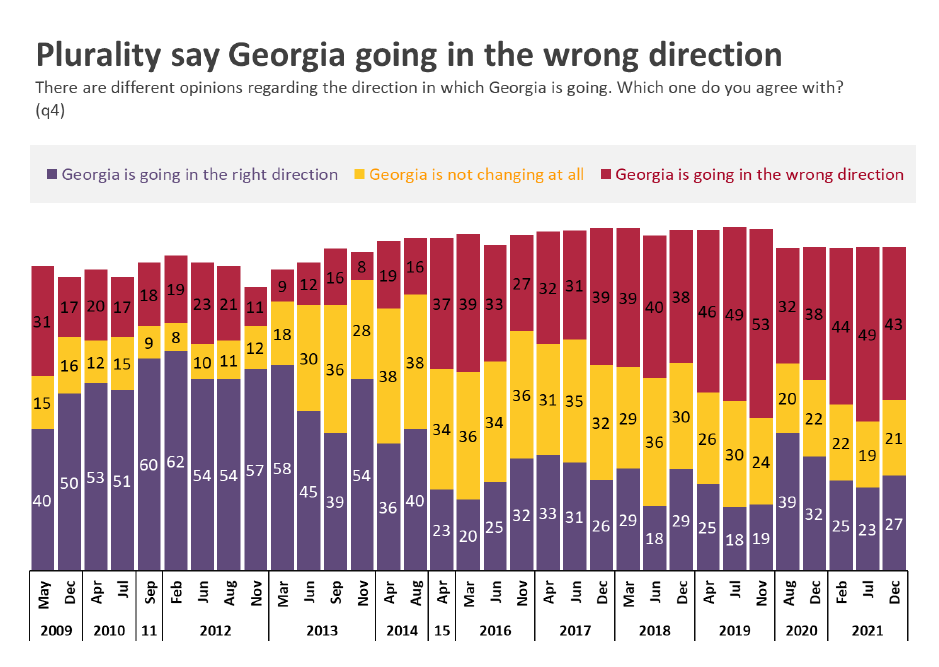
New poll by NDI Georgia: Majority says nobody acts in their best interest

27.01.2022 (Press Release)  Poll results released today by the National Democratic Institute (NDI) and CRRC Georgia find that Georgians see insufficient progress on the top national issues of concern and think the situation regarding poverty, crime, territorial integrity, and education has gotten worse in the last 10 years. 
Public concerns are consistent across political affiliation, signaling opportunities for political parties to work together to address the common needs of Georgia’s citizens. 
▶ ქართულად: Read the Georgian version here.

New poll finds that a majority of Georgians do not think anyone - neither government or opposition parties - is acting in their best interest. Georgians also remain skeptical of the newly elected parliament’s willingness to address their concerns. More than half of the population (53 percent) does not believe parliament is passing legislation on issues that matter to them, while 52 percent do not believe an MP will take action if citizens tell him/her about problems in their district. Only a third believes that parliament regularly communicates with the public.

Ambassador Gert ANTSU: ”We just cannot afford to lose interest in Eastern neighbors”

19.01.2022 (Caucasian Journal). In December 2021, the leaders of the EU and of the Eastern Partnership (EaP) met for the Eastern Partnership Summit in Brussels. It was the first EaP summit in four years. EaP is a joint policy initiative launched in 2009 to strengthen relations between the EU and its six neighbours: Armenia, Azerbaijan, Belarus, Georgia, Moldova and Ukraine.  

To better understand the results of EaP Summit, Caucasian Journal asked Ambassador Gert ANTSU (Estonia), Special Envoy of the Ministry of Foreign Affairs for the Eastern Partnership, to comment on the future of EaP and relations between EU and South Caucasus states. This is the second interview of Gert Antsu to CJ; the first one can be found here.

▶ ქართულად: Read the Georgian version here.

▶ Հայերեն: 
Read the Armenian version here.

Alexander KAFFKA, editor-in-chief of CJ:  Many people across Europe and our region in particular have been looking forward to the EaP Summit. Now, we have seen the official statements as well as some experts’ opinions, but have been seeking for the insider’s comments – well-informed, neutral, and professional. Did you have any high (or low) expectations from the recent EaP Summit? Was there anything that surprised you, in other words was very different from what was expected?

Gert ANTSU: I would say that the expectations were moderately high – after all, there had been no summit for four years, and meeting up at the level of heads or state was already a positive political signal. Furthermore, there had been ample time to put together and discuss the future goals and set-up of Eastern Partnership – at least between the EU member states. Even if there was not to be a revolutionary change in the Partnership, the steady continuation of integration of the partner countries with the EU was a worthy aim, and I very much hoped that any possible squabbles over the wording of the joint declaration would not derail the real integration process. There were difficult negotiations between the EU member states and also between the EU and the partner countries, but I am happy that in the context of high geopolitical tensions it all ended well, we got an agreement on the joint declaration, and in 2022 we can start implementing the new directions of the policy.

AK:  Could you share your overall impression of the Brussels Summit? Is there anything you might add regarding the countries from Association Trio (Georgia, Moldova, and Ukraine) in particular? 

Levan BOUADZE: "We always carried our little Georgia with us"

16.01.2022 (Caucasian Journal) Today we are pleased to meet with Mr. Levan BOUADZE  – a Georgian national serving as UNDP Resident Representative at Pacific Office in Fiji, responsible for UN development activities in a vast region consisting of 10 island nations.
With this interview, we continue  to cover various aspects of UNDP activities. Our first UNDP interview was with Resident Representative in Georgia (see here). 

Alexander KAFFKA, editor-in-chief of CJ:  Dear Mr. Levan, welcome to Caucasian Journal, Happy New Year! According to Georgian tradition, you are our “mekvle” (tracklayer) – the first guest who steps in. You are one of the Georgians who managed to build a successful international career, living far away from your homeland. May I start with a philosophical question: What happens to a Georgian identity after so many years away – is it getting stronger or washes away? Do you still practice traditions such as “mekvle”, for example?

Levan BOUADZE: Thank you, Alexander, for the opportunity to talk to your journal. Thanks for New Year greetings and from my part I also wish you and your readers a great and, importantly, healthy 2022. Sorry, I would not be able to hand sweets and candies virtually, so not a typical mekvle really😄.

It is already 26 years that I have been away from my homeland. Whether this has changed my Georgian identity, not sure if I ever thought about it. Clearly, who I am is firmly rooted in the value system that my (very) Georgian parents instilled on me which, in itself, was nurtured by the culture and traditions I was growing up with. Being away and living and working in foreign countries, certainly enriched my experiences and expanded my horizons, but I do not think that took away who I am. Furthermore, being married to a Georgian wife and having three Georgian kids, we always carried our little Georgia with us wherever we went and kept all our traditions very much alive including that of mekvle.   

Caucasian Journal's Nordic and Baltic Interviews: Two Years of Success

06.01.2022 (Caucasian Journal). Happy New Year to all the readers of Caucasian Journal! 

Almost two years ago we started a program of interviews "BEST NORDIC AND BALTIC PRACTICE" (BNBP) with high-level practitioners from Western Europe who share their knowledge in areas relevant to our region. 

BNBP has proved to be very successful, and we are happy to tell this program will continue in 2022, bringing you more speakers, more expertise, and more new themes of importance. Those who are interested in BNBP interviews are welcome to review our presentation, which summarizes the first two stages of our project. And in addition, a regularly updated list of interviews is available here

Two years of Covid in South Caucasus at a glance

18.12.2021 (Caucasian Journal). As the world is approaching 2 years of Covid pandemics, Caucasian Journal is posting a comparison of Covid-19 situations across the South Caucasus region. 
The graphs are per capita, so they give an objective picture of success/failure in fighting the pandemics. We will also seek for expert opinions to comment on the trends, so this post is to be updated. 


University of Zürich offers paid fellowship opportunities for research on South Caucasus

17.12.2021 (Caucasian Journal). For the spring semester of 2022, the Center for Eastern European Studies (CEES) at the University of Zurich offers up to five residential fellowships to highly talented and innovative young or mid-career scholars from the field of social sciences or humanities. 

Applicants with research focused on South Caucasus are particularly encouraged.  "While we welcome research proposals on all topics related to the study of Eastern Europe and post-Soviet Eurasia, for the fall spring 2022 Fellowship Program, we are particularly interested in applications from scholars with an interest in geopolitical trends, economic connectivity and/or transnational social and/or cultural issues related to South Caucasus region", - reads the call for applications. 

Funding includes accommodation, health insurance, visa support, and a stipend for living expenses during the period of stay of up to four months.  The deadline of application is January 15, 2022.  Application details are here.