Showing posts with label Georgia. Show all posts

Pegor PAPAZIAN: "TUMO Kutaisi represents an interesting public-private partnership model"

Pegor Papazian for Caucasian Journal25.08.2026 (Caucasian Journal) We are glad to reconnect today with Pegor PAPAZIAN, Co-Founder and Chief Development Officer of the TUMO Center for Creative Technologies in Armenia. We meet on the occasion of the launch of the new TUMO Center in Kutaisi, Georgia, to discuss TUMO's evolving footprint across the region.

A key architect of TUMO's global expansion, self-learning ecosystem, and educational vision, Pegor previously spoke with Caucasian Journal in 2022 about TUMO's "super-goal" of democratizing cutting-edge digital education for every teenager (read our previous interview with Pegor Papazian here).

Alexander KAFFKA, editor-in-chief of Caucasian Journal: Caucasian Journal has been following TUMO’s journey in Georgia from the beginning. For a while, though, establishing a permanent footprint here seemed to move at a different tempo compared to TUMO’s rapid expansion elsewhere internationally, despite geographical proximity. What finally broke the dam? Was there a specific moment, a political signal, or a shift in intergovernmental dynamics that turned a long-standing dialogue into the Kutaisi reality?

Pegor PAPAZIAN:  I would not point to a single moment or signal. What finally made the difference was the convergence of several factors that had been developing over time.

“Visegrad Lessons” Project Successfully Completed: What Can the South Caucasus Learn from Central Europe?

Visegrad Lessons Collage
13.05.2026 (
Caucasian Journal). After several months of discussions and expert exchanges, the project Visegrad Lessons has been successfully completed.

The initiative brought together nearly 40 experts from Central Europe and the South Caucasus — including diplomats, researchers, civil society leaders, journalists, and policy specialists — to examine an increasingly important question: Can countries continue practical cooperation even when politics become deeply polarized?

The answer from many participants was clear: Yes, if cooperation is built around practical interests rather than political unanimity.

The project explored how the experience of the Visegrad countries — the Czech Republic, Poland, Slovakia, and Hungary — may offer useful lessons for Georgia and the wider South Caucasus. We are thankful to the International Visegrad Fund, Arnika, EUROPEUM, Visegrad Insight, and the Central European Forum for support.
 

Thomas de Waal: "The Age of Conflict Has Indeed Passed" (video)

Thomas de Waal during the interview with Caucasian Journal
08.03.2026 (Caucasian Journal). In this insightful interview, Caucasian Journal welcomes Thomas de WAAL,  senior fellow at Carnegie Europe and one of the world's foremost experts on the South Caucasus. Reflecting on over three decades of experience, de Waal discusses the profound shifts reshaping the region following the mass exodus of the Armenian community from Nagorno-Karabakh—a scenario that once seemed unthinkable. He shares a cautiously optimistic view, suggesting that while the human tragedy is immense, the "age of conflict" between Armenia and Azerbaijan may finally be giving way to a new era of normalization.

The conversation delves into the critical challenges ahead, from the fate of Armenian detainees in Baku to Prime Minister Pashinyan’s precarious political standing ahead of the June 2026 elections. De Waal also analyzes the "American moment" in the region, including the strategic implications of the Trump Route for International Peace and Prosperity (TRIPP). Whether the South Caucasus can transform into a stable, integrated transit hub or remains a "sandwich" between rival powers is the central question of this timely discussion.

To be the first to view exclusive interviews, please subscribe here to our YouTube Channel.


Experts discuss Visegrad Four experience in scientific and environmental cooperation (watch or read)

Webinar 2
19.02.2026 (Caucasian Journal). Last month, the Caucasian Journal convened our second Visegrad Four + Georgia webinar, “Academic and Scientific Cooperation; Environmental Challenges: Joint Responses,” organized in cooperation with our project partners: Arnika (Czechia), EUROPEUM Institute for European Policy (Czechia), Visegrad Insight (Poland), and the Central European Forum (Slovakia).

This webinar marked the second event within the project “Visegrad Lessons for Georgia – Overcoming Political Divides through Practical Cooperation.” To read about the first webinar in the series, click here. Further expert discussions will follow. 

▶ ქართულად: The Georgian version is here.

To be the first to view exclusive interviews, please subscribe here to our YouTube Channel


ACADEMIC AND SCIENTIFIC COOPERATION; ENVIRONMENTAL CHALLENGES: JOINT RESPONSES

Alexander KAFFKA, editor-in-chief of Caucasian Journal: Good morning and good afternoon. I am Alexander Kaffka, and I will be moderating our second webinar. It's my pleasure to thank the International Visegrad Fund for supporting this project.

As we have already observed, the Visegrad Group has experienced serious political disagreements among the member states, yet cooperation has often been preserved in areas that are less politically sensitive, but still strategically vital, such as academic exchange, scientific research, and environmental policy. Georgia and the South Caucasus in general face a different political and institutional context, but similar risks – deepening polarization, fragile institutions, and shared environmental and scientific challenges. 

Experts discuss Visegrad Four experience and lessons for the Caucasus (watch or read)

Webinar 1
18.01.2026 (Caucasian Journal). Last month, the Caucasian Journal convened the first Visegrad Four + Georgia webinar, “Political Differences, Practical Unity: The Visegrad Experience,” organized in cooperation with our project partners: Arnika (Czechia), EUROPEUM Institute for European Policy (Czechia), Visegrad Insight (Poland), and the Central European Forum (Slovakia).

This webinar marked the first event within the project “Visegrad Lessons for Georgia – Overcoming Political Divides through Practical Cooperation.” Further expert discussions will follow, focusing on various fields, including business and economics, scientific cooperation, and environmental cooperation.

▶ ქართულად: The Georgian version is here.

To be the first to view exclusive interviews, please subscribe here to our YouTube Channel


In a landmark webinar hosted by the Caucasian Journal, experts from the Visegrad Four (V4) and Georgia gathered to discuss a pressing question: How can nations maintain practical cooperation when political leaders are at odds? As Georgia navigates a challenging European integration path, the V4 experience offers a "realistic" model—not of perfect unity, but of resilient, functional collaboration.

Key Takeaways for Georgia


1. "Low Politics" vs. "High Politics": Ladislav Cabada (Metropolitan University Prague) emphasized that clashes in "high politics" (ideology, foreign policy) should not stop "low politics" cooperation. Trade, scientific exchange, and environmental protection must remain active even when leaders disagree.

2. The "TRIO" and South Caucasus Formats: Kakha Gogolashvili (Rondeli Foundation) highlighted that while the V4 was a lobbyist for EU entry, Georgia can look toward a "South Caucasian format" (Georgia, Armenia, Azerbaijan) for regional stability, using V4-style sectoral cooperation (SMEs, environment) as a blueprint.

"Now there is another format that is possible to use—the South Caucasian format between Georgia, Armenia, and Azerbaijan. These three countries can cooperate and use the experience of the Visegrad Group" — Kakha Gogolashvili
3. The Resilience of Civil Society: István Gyarmati and Giorgi Robakidze warned that the West must not "give up" on Georgia because of government friction. Instead, support for civil society should increase when official channels become difficult.

4. The Visegrad Fund Model: The International Visegrad Fund (IVF) remains the "only remaining asset" of true cooperation for the V4. For Georgia, creating a decentralized Civil Society Forum could protect independent media and fight disinformation.

"The Visegrad project itself is an act of defiance against history." — Marta Simeckova, Project Forum.
Watch 1-minute video highlights from Webinar 1 here. The full text version of the webinar is below:
POLITICAL DIFFERENCES, PRACTICAL UNITY: THE VISEGRAD EXPERIENCE

Alexander KAFFKA, editor-in-chief of Caucasian Journal: Despite significant political disagreements, the Visegrad Group has managed to preserve cooperation in key aspects. Today's discussion is not about idealizing the Visegrad model, but about understanding it realistically, what worked, where it was fragile, and which lessons, if any, might be relevant for Georgia. With that, let me turn to our first question. What is the single most important factor that allowed the Visegrad group to maintain cooperation despite serious political disagreements? 

Sebastian SCHÄFFER: “The best way to preserve freedom is European integration” (watch video or read)

Sebastian SCHÄFFER at Caucasian Journal
13.10.2025 (Caucasian Journal). Today, Caucasian Journal is pleased to welcome Dr. Sebastian SCHÄFFER, Director of the Institute for the Danube Region and Central Europe (IDM) in Vienna, Austria — one of Europe’s oldest and most respected think tanks, dedicated for over 70 years to fostering cooperation, research, and dialogue across Central and Eastern Europe.
 
▶ ქართულად: The Georgian version is here.

To be the first to view exclusive interviews, please subscribe here to our YouTube Channel


The full text version of the interview is below:

Sebastian SCHÄFFER: “THE BEST WAY TO PRESERVE FREEDOM IS EUROPEAN INTEGRATION”

Alexander KAFFKA, editor-in-chief of CJ: Today, CJ is pleased to welcome Dr. Sebastian SCHÄFFER, Director of the Institute for the Danube Region and Central Europe (IDM) in Vienna, Austria. Welcome to the Caucasian Journal, Sebastian! You are the head of this Vienna-based think-tank, studying Central and Eastern Europe for many years. How can you introduce IDM to our viewers and readers today? 
   
Sebastian SCHÄFFER: First of all, thank you very much for the invitation. It's a great pleasure to talk to you today, and I'm very honored that we have this opportunity.  If I were to briefly describe what we are doing, we are centered around what we call “5 P's”. Out of these P's the most important is our Platform. We work with 19 different countries in the wider Danube region, and we have institutions that we work together. 

Helfried CARL: “I just hope that Georgia doesn't miss the train” (watch video or read)

07.10.2025 (Caucasian Journal). Vienna, the capital of Austria, currently holds the prestigious title of European Capital of Democracy. What exactly does it imply, and why was Vienna selected for it? 

Helfried Carl at CJTo explore this, the Caucasian Journal has the unique opportunity to speak to Mr. Helfried CARL, the Austrian diplomat and political strategist, founder of the European Capital of Democracy and The Innovation In Politics Institute. 

▶ ქართულად: The Georgian version is here.

To be the first to view exclusive interviews, please subscribe here to our YouTube Channel


The full text version of the interview is below:

Helfried CARL: “I JUST HOPE THAT GEORGIA DOESN'T MISS THE TRAIN”

Alexander KAFFKA, editor-in-chief of CJ: Welcome to Caucasian Journal! What is the "European Capital of Democracy" about, and how are you personally involved in it?
   
Helfried CARL: Thank you very much for the invitation. Okay, so I have probably to start from the very beginning. European Capital of Democracy is about the conviction that grew within me and my friends with whom I am organizing this, that there is a lot of local innovation in the field of democracy going on, and that there are two things we need to do about it:

Sadeddine MNEIMNE: “Join us where global capital meets Georgian opportunity!”

Sadeddine MNEIMNE for Caucasian Journal
10.09.2025 (Caucasian Journal) We are honored to welcome Dr. Sadeddine MNEIMNE (Lebanon – UAE), Chairman of AGI Holding and the main driving force behind the upcoming Global Investors Forum (GIF), planned for December 4-6 in Tbilisi. 

As the official media partner of the GIF, the Caucasian Journal interviews the businessman on his background, the business environment in the region, and his vision for the upcoming event.

▶ ქართულად: Read the Georgian version here.

Alexander KAFFKA, editor-in-chief of Caucasian Journal: You are a Lebanese entrepreneur based in the Emirates, with significant business interests extending to Georgia. What are three aspects of Georgia you find most appealing—or perhaps challenging?

Sadeddine MNEIMNE: Georgia has a very special place in my journey — in fact, our work in Georgia began three years ago, even before our expansion into the Emirates. It was one of the first markets where I recognized the potential to build long-term, sustainable ventures. Its strategic location as a bridge between Europe and Asia was what initially drew me, because it offers natural access to two continents and lies at the heart of modern Silk Road trade routes.

The Armenia-Azerbaijan TRIPP Agreement: Experts Offer Analysis

13.08.2025 (Caucasian Journal) The recent breakthrough agreement between Armenia and Azerbaijan, brokered with the assistance of the U.S. President, which establishes the "Trump Route for International Peace and Prosperity (TRIPP)"—also known unofficially as the Zangezur Corridor— has prompted a range of mixed reactions. 

In Georgia, the deal has caused a particular divide. While political rivals like current Prime Minister Irakli Kobakhidze and former President Salome Zourabichvili have found a rare moment of unity in welcoming the development, former President Mikheil Saakashvili has called it "the most serious geopolitical catastrophe for Georgia."

Today, the Caucasian Journal is presenting the opinions of international experts. We reached out to them to answer the following two questions:

▶ What are the likely long-term political and economic consequences of this agreement for Georgia?

▶ With a renewed and visible U.S. diplomatic presence in the region, do you believe the South Caucasus will ultimately benefit from this changed geopolitical situation both in the region and beyond?

Zangezur - TRIPP map


Ambassador Ashot SMBATYAN: "Friendly relations between Armenia and Georgia have reached their political peak"

Ashot SMBATYAN 2025
29.07.2025 (Caucasian Journal) The Caucasian Journal is pleased to welcome His Excellency Ashot SMBATYAN, the Ambassador of Armenia to Georgia, for our second interview.

Since the Ambassador’s previous interview in 2023, significant developments have occurred in Armenia, the South Caucasus, and globally. We hope to address all major topics in this conversation.

▶ Հայերեն. Read the Armenian version here.
▶ ქართულად: Read the Georgian version here.

Alexander KAFFKA, editor-in-chief of CJ: Your Excellency, since we are in Tbilisi, let’s begin with Armenia–Georgia relations. Our countries now have a Strategic Partnership Agreement signed about 18 months ago. Beyond its evident symbolic weight, what tangible results have been recorded, and what future initiatives are being developed? In addition to political and economic dimensions, could you also comment on military cooperation as outlined in the agreement signed last year by the defense ministers of Armenia and Georgia?

Ashot SMBATYAN: Yes, you are absolutely right, for over 30 years now, the friendly relations between Armenia and Georgia have reached their political peak, and in January 2024, the Prime Ministers of Armenia and Georgia signed the Joint Declaration on Establishing a Strategic Partnership between the Republic of Armenia and Georgia in Tbilisi. This elevated our relations to a qualitatively new level and laid the foundation for further deepening of bilateral ties in various fields.

Sjur BERGAN: “I don't think you can have democracy without good education” (watch video or read)

Sjur BERGAN Caucasian Journal
24.07.2025 (Caucasian Journal). What is the relationship between education and democracy? Why is EU membership important for education? 

The Caucasian Journal has a rare opportunity to pose these and other questions to Sjur BERGAN, one of Europe's leading education policymakers. He served as the head of the Council of Europe's Education Department for many years and played a pivotal role in shaping European higher education policy. Previously, he represented the CoE in the Bologna Follow-Up Group for over two decades, chaired the working groups on structural reforms, and was the main author of the landmark Lisbon Recognition Convention.

▶ ქართულად: The Georgian version is here.

To be the first to view exclusive interviews, please subscribe here to our YouTube Channel


The full text version of the interview is below:

Sjur BERGAN: “I DON'T THINK YOU CAN HAVE DEMOCRACY WITHOUT GOOD EDUCATION”

Alkis DRAKINOS: “The three Caucasian countries are the perfect conduit for trade between Asia and Europe”

Alkis Drakinos
26.06.2025. (Caucasian Journal) The European Bank for Reconstruction and Development (EBRD), a key driver of economic development in Central and Eastern Europe, Central Asia, and the Southern and Eastern Mediterranean, is also an active player in the South Caucasus. The Bank's investments in private enterprise, infrastructure, and sustainable development are very significant. 

Today, we are privileged to interview Alkis Vryenios DRAKINOS, Director and Regional Head of the Caucasus for the EBRD, who began his tenure in Tbilisi in 2023. 

▶ ქართულად: The Georgian version is here.

Alexander KAFFKA, editor-in-chief of Caucasian Journal: Dear Alkis, welcome to Caucasian Journal! Thank you for your time. You’re no stranger to our region, correct? Could you begin by sharing your professional background and previous experience in the South Caucasus?

Alkis DRAKINOS: Dear Alexander, many thanks for inviting me to the Caucasian Journal. I see it as a privilege to have the opportunity to share my experience and views with your readers. Yes, you're right, I'm not a stranger to the Caucasus. I first visited the region 30 years ago when I was a young Associate Banker at the EBRD, and it all started here in Tbilisi! This was my first professional visit bearing the business card of EBRD in a country of operations of the Bank, and it marked me for life.
     

Diana PAVELESCU: “EU standards give consumers confidence that what’s on the wine label is exactly what’s inside”

Diana PAVELESCU
06.05.2025. (Caucasian Journal)  We always seize the opportunity to discuss winemaking, since it's such a vital industry in our region. So, what’s in store for winemakers in EU candidate countries like Georgia and Moldova as they look to integrate into the EU? Can they expect changes in pricing, quality control, and subsidies as they align with European standards? 

Our guest today, Diana PAVELESCU from Romania, is here to shed some light on these questions. Diana is the Secretary-General of ADAR (the Romanian Authorized Wine Tasters' Association) and the founder of the Romanian Wine Academy. She’s also a Wine Ambassador and has served as a wine advisor to the Romanian Minister of Agriculture, as well as a juror in various international wine competitions. 

▶ ქართულად: The Georgian version is here.

Alexander KAFFKA, editor-in-chief of Caucasian Journal: Dear Diana, welcome! Romania went through a big shift when it joined the EU. What are the key takeaways about how the situation changed or how local wines stacked up against the imports? Do you think Romanian winemaking has experienced major changes due to EU membership? 

Diana PAVELESCU: Thank you for the invitation — it’s an honor to share our experience with you and your readers. I should mention that I currently work with Romania’s National Office for Vine and Wine Products, the institution responsible for vineyard certification and trade authorization for wines with protected designations of origin (PDO) and geographical indications (PGI).

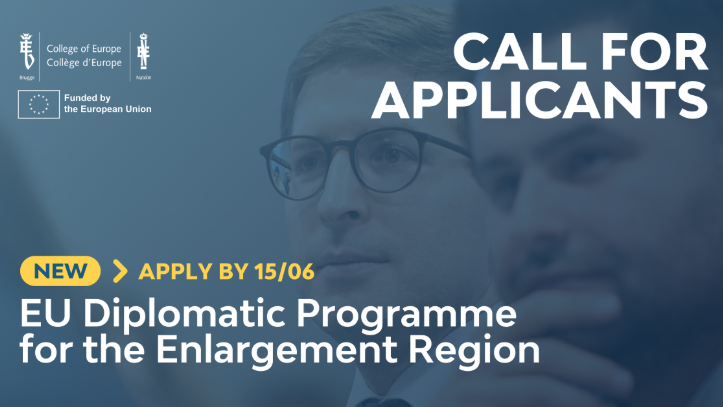
Georgians are invited to apply for a 5-month Diplomatic Programme at the College of Europe in Belgium

European Union Diplomatic Programme
18.04.2025. (Caucasian Journal). The College of Europe in Bruges (Belgium) has launched a call for the second edition of the European Union Diplomatic Programme for the Enlargement Region. The school is expected to run from 31 August 2025 until 31 January 2026.

This programme, funded by the European Commission, aims to foster regional cooperation among junior diplomats and/or officials of the enlargement region and their EU peers by strengthening their knowledge in EU affairs. The curriculum includes joint activities with the EU Diplomatic Academy.

The call is especially tailored towards junior diplomats and/or officials working in the field of foreign policy and EU accession from Georgia, the Republic of Moldova, Ukraine, and other candidate countries. 

Lasha BREGVADZE: "The Georgian criminal subculture originated from people dedicated to the liberation of their country"

Lasha BREGVADZE
23.03.2025 (Caucasian Journal). Today we are discussing quite a critical theme – the problem of organized crime – with one of the best experts in this field, Dr. Lasha BREGVADZE, the Head of the Organized Crime and Law Enforcement Research Center at Georgian Strategic Analysis Center. 

Alexander KAFFKA, editor-in-chief of Caucasian Journal:  Dear Lasha, thank you for your time. Organized crime is a troubling issue, but that should not deter us from addressing it. On the contrary, we must do so. International media reports frequently highlight Georgian involvement, we hear about deportations, and other related matters. I hope you will shed light on these topics for our readers. To start, I have a question: How did you become so deeply invested in this subject, leading to your dissertation?

Lasha BREGVADZE:  I was only 22 years old during the Rose Revolution of 2003.  That's when I was integrated into the law enforcement agencies. It was a tough time for Georgia. I was initially appointed as an investigator for special cases at the Ministry of Security, which was the name of the organization at the time. Later, I was transferred to the General Inspectorate of the Ministry of Justice, where I took on the role of Head of the Financial Audit Division.

Maestro Usui TOSHIKI: "I am absorbing the beautiful sounds from Georgia like oxygen"

19.03.2025 (Caucasian Journal). The Caucasian Journal is honored to welcome Maestro Usui TOSHIKI, an internationally acclaimed Japanese pianist often described as a "cultural bridge" between Japan and Georgia. Beyond his virtuosic performances, Usui serves as general manager of the Yokohama and Omi Sinfoniettas.
Maestro Usui TOSHIKI

Alexander KAFFKA, editor-in-chief of Caucasian Journal:  Dear Usui-san, welcome to Caucasian Journal. First of all, I must say that I attended your performance in Tbilisi last year and became your fan. Thank you for your art! I was intrigued, however, to learn you are an honorary citizen of Sighnaghi, a small but extremely picturesque town in Eastern Georgia. Can you share the story behind this connection, to start our conversation?

Usui TOSHIKI: Thank you very much. It has been almost 10 years since I first visited Georgia. During my second visit, I went to the city of Sighnaghi. My first impression of it was that it was a perfect city, with traditional architecture, rich nature, and wonderful wine and food. Since then, every time I visit Georgia, I have had wonderful times visiting many wineries in Sighnaghi and holding concerts. 

Toyota: Weaving the Future from Mount Fuji to the Caucasus

30.01.2025 (Caucasian Journal). In the summer of 2019, the Caucasian Journal was excited to publish a detailed article about a groundbreaking plan to start producing the first electric cars in the Caucasus region. The first Georgia-made electric vehicles (EVs) were expected to roll out of the plant in Kutaisi in December 2019, but unfortunately, this did not happen. Since then, environmental challenges in our region and potential "green" solutions have remained a priority for us.

Meanwhile, the environmental situation in the region has continued to deteriorate, primarily due to the growing automotive fleet. The transport sector is the largest source of CO2 emissions, accounting for 40 percent of total energy-related CO2 emissions, according to a recent report of the International Energy Agency. 

Toyota Woven City
Toyota Woven City. Image: Toyota
The Georgia Alliance for Safe Roads, a non-governmental organization, has emphasized that the issue extends beyond fuel distribution and poses risks to human health. It seems vital to shift to less carbon-intensive modes of transport, particularly electric and other alternative-powered vehicles.

▶ ქართულად: The Georgian version is here.


Can Technology Help?

What alternatives do Georgia—and the South Caucasus in general—have in the near future to improve the environment and ensure healthier conditions for its people? 

Inger ENKVIST: “We have for a long time lived on the results of our past very high educational standards” (watch video or read)

Inger Enkvist Caucasian Journal
27.01.2025 (Caucasian Journal). Is it possible to "import" the Nordic education model? What are the strengths and weaknesses of European education? How does EU membership affect national education policies? 

These are some of the questions that we are discussing today with Inger ENKVIST, Professor Emerita from the Lund University in Sweden. Professor Enkvist is a distinguished Swedish educator and writer, one of the most renowned commentators on education policies, and an expert in Spanish literature. 

▶ ქართულად: The Georgian version is here.

To be the first to view exclusive interviews, please subscribe here to our YouTube Channel


The full text version of the interview is below: