Showing posts with label COVID. Show all posts

Laura Thornton: "Democratic backsliding is like the pandemic. It is contagious"

21.05.2021 (Caucasian Journal) Caucasian Journal’s guest today is Ms. Laura THORNTON, Director of the Alliance for Securing Democracy at German Marshall Fund. We are proud to add that Laura is our journal’s good friend and member of our Board. 

Alexander KAFFKA, editor-in-chief of Caucasian Journal: Dear Laura, it is always a pleasure to meet you – virtually for the time being, but maybe also in person before long:  I know that you are planning to be back to Georgia soon. You have worked in Tbilisi for a long period as the head of National Democratic Institute, so you are one of the most competent international experts when it comes to Georgia’s politics and sociology. What’s your attitude to Georgia now, and will you be visiting us this time as an expert? 
 
Laura THORNTON: Well, I am not sure I am an expert, just an interested observer! My attitude toward Georgia is always one of hopeful optimism and desire for the country’s success. I believe Georgia faces similar challenges to many other places, including my own country. There is an alarming rise of authoritarian threats – both external and internal – which is impacting the quality of our democratic function. Deep polarization is paralyzing governance and thwarting democracy’s ability to deliver, which drives people into the arms of illiberal forces. Information integrity is the subtext of much of this, with disinformation efforts sowing discontent and exacerbating divisions. As I’ve said before, democracy is Georgia’s greatest asset and I believe in Georgian democrats to overcome these challenges by supporting pluralism, checks and balances, a robust civil society, and rule of law.


Yiftah CURIEL: "Potential of digital diplomacy is immense"; Ran GIDOR: "Women belong in all places where decisions are made"


global focus
voices of Israeli Foreign Ministry
27.10.2020.
Caucasian Journal from time to time presents to our readers articles which focus on issues of a wider international importance. Today under our "GLOBAL FOCUS" Caucasian Journal gives floor to the Israeli diplomats.
 
The subjects they cover reflect important aspects of Israeli foreign policy: Use of latest "cutting edge" technologies, and adherence to decades-proven "classic" achievements accumulated by humanity. While Yiftah CURIEL of Israeli Foreign Ministry talks about digital diplomacy in the COVID era, Ran GIDOR – Israeli Ambassador to Georgia – remembers the anniversary of UN Security Council Resolution urging to increase women's decision-making in the sphere of peace and security.
  
Yiftah CURIEL: "The potential of digital diplomacy is immense"

Mr. Yiftah CURIEL is Director of Department for Digital Diplomacy at Ministry of Foreign Affairs of Israel.

Alexander KAFFKA, editor-in-chief of Caucasian Journal: Dear Yiftah, welcome to Caucasian Journal! As you are the head of Israel’s digital diplomacy, do you agree that wider digitalization is one of main ways to survive, especially in the era of COVID?

Yiftah CURIEL: Hello, and thank you for this interview, providing this opportunity to speak with your audience. Absolutely, I think that although digitalization, and specifically digital diplomacy, has been rapidly expanding over the last few years, COVID and the need to connect from afar, has accelerated this process. We have seen on our digital platforms a significant rise in the number of followers, people that want to connect with Israel, from tourists to businesspeople to religious pilgrims, and we've tried to accommodate them by providing content, a way to interact with us that would alleviate some of the difficulties of not being able to connect face to face. 
 

Sebastian MOLINEUS (video): "Digital economy is key driver for growth and a critical aspect of response to COVID"

25.08.2020 (Caucasian Journal)  What is the main focus of World Bank's activities in the South Caucasus? What type of investment projects are in especial demand in our region? How did Georgia's COVID response influence the  business environment?

Our today's video discussion with Mr. Sebastian MOLINEUS centers around these questions. Mr. Molineus, World Bank Regional Director for the South Caucasus, is already well known to readers of Caucasian Journal. 

Today for the first time we are pleased to offer his interview in a video format.

Watch video interview with Sebastian MOLINEUS below.

To be first to view all our exclusive video interviews, please subscribe here to our YouTube Channel.


Zaza BIBILASHVILI: "Democratic backsliding is evident"

Zaza BIBILASHVILI:27.07.2020 (Caucasian Journal)  How is the political and economic situation in Georgia seen from a viewpoint of one of the country's leading  professional lawyers?  

Today Caucasian Journal is pleased to present the answers given by  Zaza BIBILASHVILI, Senior Partner at BGI Legal, Georgia’s leading independent law firm, and founder of the Chavchavadze Center for European Studies and Civic Education. 

Alexander KAFFKA, editor-in-chief of Caucasian Journal: Dear Zaza, thank you for being with us, and for your attention to Caucasian Journal – we are privileged to have you among our Board members. Let me start with what I consider central. You possess a rare - if not ideal - combination of professional and personal qualities, which make you equal to political challenge of any caliber. Recently you left UNM - the party, which you joined in 2013, and where you held a senior position. You said you would not associate with any other political force or take part in the 2020 elections. I am sure you had important reasons, but what will remain on the plate for the voter, if all the very best professionals would decide to step away?

Zaza BIBILASHVILI: Alex, thank you for inviting me for this interview. The honor is all mine to be on CJ board along with such distinguished group of individuals. Let me start by wishing you and Caucasian Journal all the best. I know there are quite a few new ideas and plans for the immediate future. Look forward to seeing the Journal grow! On to your question: 

I joined UNM in 2013. Georgia’s former ruling party had already lost the 2012 parliamentary elections. It was widely demonized, its members were targeted politically and persecuted by all branches of government. Hundreds were jailed or forced to flee Georgia, and thousands were pressured in various ways. Against this background, many struggled to explain my move – in a country where people are quick to switch camps to join the winner, it is rare to see a successful citizen, who had never been part of the government and with no vested interest, to risk it all for no apparent gain. 

Meni BENISH of Israel-Georgian Chamber of Commerce: "We can get financial support for any size of ventures"

13.07.2020 (Caucasian Journal) Israel is among the Georgia’s oldest and most reliable business partners. An essential support mechanism for healthy economic relations is a bilateral chamber of commerce, which, as a rule, must be established in both countries. 

Recently such a bilateral chamber has been finally introduced, after a lengthy period of registrations and endorsements in Israel and Georgia. Today Caucasian Journal talks with the head of new Israel-Georgian Chamber of Commerce (IGCC), Mr. Meni BENISH (Read Georgian version here.)

Alexander KAFFKA, editor-in-chief of Caucasian Journal: Dear Mr. Benish, thank you for attention to Caucasian Journal. When I heard about the launch of your Chamber of Commerce (CoC), I thought that we must cover this news, because Israel is such an important country for Georgia, and also because we partner with International Chamber of Commerce and other organizations promoting business participation in civil society. For businesspeople in Georgia, what is going to change with installation of your CoC? What new opportunities will open for an ordinary entrepreneur, and when?

Meni BENISH: First, I would like to thank you for the warm wishes. As you may know, I was born in Poti, and I am a Georgian citizen. Georgian people are close to my heart and I can clearly say that I feel at home in Tbilisi.

Aspen Ministers Forum: 27 Foreign Ministers Issue Call for UN

June 14, 2020. Caucasian Journal is happy to share and support this Aspen Institute's initiative. We are proud to have two European Aspen Institutes among our official partners. The statement below was released by members of the Aspen Ministers Forum on June 12, 2020. The signatories are acting in a personal capacity, and this statement does not represent an official position taken by the Aspen Ministers Forum or the Aspen Institute.

We are a group of former foreign ministers from every region of the world, who bring to bear decades of experience in conducting international diplomacy, responding to crises, and reforming international institutions. Never before have we seen a challenge as acute, complex, far-reaching, and potentially long-lasting as the COVID-19 pandemic. While many nations have been able to implement effective interventions through social distancing, testing and contact tracing, the first wave of the virus is not yet over and the pandemic continues to pose a risk to the lives and livelihoods of people in every nation on earth.
Photo: Aspen Institute

As with many of the threats we face, the virus does not respect boundaries and therefore cannot be defeated by any country acting alone. To respond to this pandemic and prevent future outbreaks, nations must combine their strengths.

We have seen the benefits that cooperative action can bring. During our careers, world leaders worked to build and strengthen regional and global institutions to spur development, prevent war, promote health, regulate trade, and prosecute crimes against humanity. Although certainly not every decision made was the right one, the mechanisms created helped resolve dangerous conflicts and brought about unprecedented gains in alleviating poverty, expanding literacy, and containing the ravages of communicable diseases.

Ambassador Ran GIDOR: "We’ve been spending too much time toasting each other"

13.06.2020 (Caucasian Journal) Today Caucasian Journal has the honour to talk with the newly appointed Israeli ambassador to Georgia, Mr. Ran GIDOR. His term in Tbilisi started last January. 

Mr. Gidor is not a newcomer in Georgia: Being a career diplomat, he was appointed as deputy ambassador in Tbilisi (accredited to Georgia and Armenia) back in 1997. His subsequent experience included positions of Cultural and Academic attaché in Beijing, Political Counsellor in London, Director of UN Political Affairs Department, and Ambassador to Cameroon, the Central African Republic, Equatorial Guinea, Congo and Gabon.

Alexander KAFFKA, editor-in-chief of Caucasian Journal: Your Excellency, welcome to Caucasian Journal, we thank you for attention to our readers. I know it became commonplace to talk about the coronavirus, but in your case I cannot help asking: How does it feel to start an Ambassador’s term in an unprecedented lockdown? I understand that just weeks after arrival in Tbilisi you found yourself isolated at home and unable to travel, being cut from essential parts of every diplomat’s work.

Ran GIDOR: Thank you, Alexander, for the opportunity to address your readers. Yes, you’re absolutely right, COVID-19 has “turned the tables” (so to speak…) on all our original work plans for 2020 and forced us to cancel virtually every major project in the pipeline. However, now we’re ‘regrouping’ and learning how to implement some new ideas in innovative and unconventional ways. As always, what starts as a threat or a disaster – can be turned into an opportunity, if we’re prepared to rise to the challenge.

Valeri CHEKHERIA: "We are shaping new Georgia and placing it on world map"

05.06.2020 (Caucasian Journal) Is Georgia prepared to welcoming foreign tourists next month? How does the big business coordinate actions with the government in hospitality sector, which is strategic for Georgia? Do corporations play a role in formation of civil society?

Our today's guest is Valeri CHEKHERIA, CEO of Adjara Group. His name is not only behind some of the Georgia's newest and most iconic hotels, but also in many board lists of important non-profit organizations.

Alexander KAFFKA, editor-in-chief of Caucasian Journal: Dear Valeri, welcome to Caucasian Journal. Last year we planned to talk about your success story of interaction between business and civil society, and the Democracy Frontline Center, and I hope we will touch this today. But now the whole world is turned upside down by the pandemic, which is the top factor everywhere – and especially in tourism-dependent businesses such as yours. How severely your hospitality projects have been hit by COVID measures? 

Valeri CHEKHERIA: The tourism industry was hit the most with hospitality sector experiencing extensive losses globally. Certainly, we are no exception and we have suffered severely from the effects of the pandemic. We had to close down all our hotels and put on hold the development of the ongoing projects. 

Dr. Laurence BROERS: "There won’t be Armenian-Azerbaijani Dayton*"

27.05.2020 (Caucasian Journal) Caucasian Journal talks with Dr. Laurence BROERS, well-known expert on conflicts in the South Caucasus with over 20 years’ experience, both as a researcher and a practitioner of peacebuilding initiatives in the region. 
Laurence BROERS
Dr. Broers is the Caucasus programme director at London-based NGO Conciliation Resources. He is Associate Fellow at Royal Institute of International Affairs (Chatham House), author or editor of several books, including Armenia and Azerbaijan: Anatomy of a Rivalry, and co-editor-in-chief of Caucasus Survey.

Alexander KAFFKA, editor-in-chief of Caucasian Journal:  Dear Dr. Broers, welcome to Caucasian Journal. We’ve wanted to talk with you since a long while, and today we have this lucky possibility thanks to an important development – the release of a new documentary about the Karabakh conflict between Armenia and Azerbaijan (to watch video, scroll down to page bottom). You have agreed to introduce this film for our readers. Allow my first question – how do you visualize the target viewers group of the documentary?

Laurence BROERS: On 12 May we released online a documentary film called Parts of a Circle: History of the Karabakh Conflict. The film chronicles the disputed history of more than 30 years of this conflict, in an Armenian-Azerbaijani co-production. It is a locally led project, in which the scripts were written, interviewees selected and films produced by local teams of Armenian and Azerbaijani journalists. The project actually began in 2011 but for a number of reasons it has taken until now to be ready for the public release. The film we have recently released is actually a shorter version, at 76 minutes, of a longer 3-hour trilogy. The short film is in English, and it is intended for an international audience that is not necessarily familiar with the Karabakh conflict. The longer trilogy has considerably more detail and is intended more for a local and a specialist audience.

Caucasian Journal offers free advertising as support for businesses, calls for other mass medias to join

We know that many businesses – both small and big – are impacted by the outbreak of Covid-19. Many companies face a long road ahead as they try to rebuild themselves following the lockdown. In this difficult time, we believe that businesses must show maximum support to each other.

We’ve listened to businesses to understand how we can support them. Caucasian Journal and its sister business news sites decided to give companies struggling in the wake of the Covid-19 pandemic free advertising.

Today we are glad to announce that from 22 May all the companies in Georgia, Armenia, Azerbaijan will be eligible to apply for free banner advertising to use across the Caucasian Journal and our sister business news sites. 

Professor Ramaz KURASHVILI: "Georgia is lucky to have world-class virologists with independent thinking"

20.05.2020 (Caucasian Journal) Professor Ramaz KURASHVILI is one of Georgia’s leading medical professionals, Director of Center for Diabetes Research in Tbilisi, Chairman of Union of Diabetic and Endocrinological Associations of Georgia, and a member of Caucasian Journal’s Board. 
We have asked Professor Kurashvili to share his views about Georgia’s response to COVID-19.

Caucasian Journal: You have large professional experience, not only medical, but also experience in the management and administration of medical institutions. How do you assess the medical and organizational level of the anti-pandemic activities in Georgia?

Ramaz KURASHVILI: The epidemic is far from over, however, we can evaluate the measures taken by the Georgian government and Georgian epidemiological virologists to date. We can say that the State Coronavirus Commission works highly efficiently: Epidemiologists, virologists, infectious disease specialists, family doctors, healthcare organizers, the police, military, media, television have actively joined in the fight against coronavirus infection; it should be noted that all television channels (in particular, Channel 1 of Georgian Television) and the media work smoothly, there are no cases of dissemination of false or panic information. Of particular note is the high authority, level of knowledge and experience of the Leading infectious diseases specialist prof. T. Tsertsvadze, Director General of the National Center for Disease Control and Public Health of Georgia prof. A. Gamkrelidze, Deputy Director of the Center prof. P. Imnadze, all the doctors of those centers that today are treating the coronavirus patients. We should thank the leaders and staff of the Ministry of Health of Georgia and the Autonomous Republic of Adjara, and the Minister of Foreign Affairs of Georgia Mr. D. Zalkaliani. Of particular note is the Prime Minister of Georgia, Mr. G. Gakharia, thanks to his efficiency, openness, and close mutually beneficial cooperation with doctors, it was possible to slow down the growth of the epidemic and to control the situation; time was used effectively to prepare healthcare for a pandemic, to create specialized centers, equip existing clinics and prepare them for patients, purchase and deliver the necessary number of tests, organize quarantine zones two-week quarantine, etc. - i.e. not to meet the blow unprepared.

Ambassador Per EKLUND: "COVID is unpredictable. I had a lucky escape"

12.05.2020 (Caucasian Journal).The Swedish response to COVID-19 is in the focus of the world's attention today. But how does it feel to recover from coronavirus in a Swedish hospital? And when the patient happens to be a former ambassador to Georgia, Caucasus Journal is especially keen about his comments.
Today we are honoured to introduce a very special guest – Ambassador Per EKLUND, Senior Fellow at the Institute for Security and Development Policy in Stockholm, former EU Ambassador to Georgia – a person widely known and deeply respected in the South Caucasus. 

He planned to spend this May in Georgia and to meet with us in person, but as COVID interrupted, instead of Tbilisi he had to go to a Stockholm's hospital. Now, after the worst is over, Ambassador Eklund has got a very unique mix of experiences, which he is sharing with our readers.

Alexander KAFFKA, editor-in-chief of CJ: Welcome to Caucasian Journal, Mr. Ambassador, and thank you for finding time for this interview. I am very glad to see you in good health after catching the notorious coronavirus infection. Allow me a somewhat personal question first. Earlier this year you celebrated your 75th birthday. Do you agree that senior citizens should follow stricter isolation rules? Should they be extra careful themselves, or is it a task for the authorities to establish different conditions for people over 60?

Per EKLUND: Well, persons who are 70+ should be careful, as we are, generally speaking, part of the risk group. And I was careful and yet got infected. And although I was in good shape, with no other diseases, no diabetes, no overweight and a non-smoker, I got severely ill. This was my second time in a hospital bed, the first was 1945, at my birth!

AK: Oh, really? And how does it feel to get through a COVID-19, especially in a severe case? Do you have a guess how you got infected?

Sebastian MOLINEUS of World Bank: "We've been working with the Governments of Armenia, Azerbaijan and Georgia since day 1 of this crisis"

22.04.2020 (Caucasian Journal) The economies of South Caucasian countries will be severely hit in long time perspective due to global pandemic – from tourism decline and (in case of Azerbaijan) from oil price drop.  As World Bank is known for economic forecasting, Caucasian Journal asked for professional comment from Sebastian MOLINEUS -  WB Regional Director for the South Caucasus.

Caucasian Journal: How does World Bank assess the economic consequences of pandemic in the countries of South Caucasus?

Sebastian MOLINEUS: The COVID-19 pandemic is presenting an unprecedented economic challenge for the world and is certainly having an impact on the economies of all three countries in the South Caucasus Region.

Indeed, the pandemic is occurring at an already fragile time for the Europe and Central Asian region, including the South Caucasus. Growth in Europe and Central Asia had already decelerated to 2.2 percent in 2019. And since February 2020, the region has faced an increasingly uphill battle to cope with the pandemic as it interrupts daily activity, puts further downward pressure on commodity prices, disrupts tightly linked global and regional supply chains, reduces travel and tourist arrivals, and decreases demand for exports from and within the economies in the region.  As a consequence, most forecasts, including the WB’s Europe and Central Asia Economic (spring) Update, project a contraction in global and regional GDP in 2020.

By how much?  The projections this time around are subject to significant uncertainty. How long the recession will last, and its severity will depend on the duration of the pandemic. The scenarios in the ECA Economic Update suggest regional GDP could contract by 2.8 percent in case the outbreak is largely contained by the second half of the year and measures to stop the spread of the virus are lifted, but the contraction could reach as much as 4.4 percent in case efforts to contain the outbreak spill into the third quarter of 2020.

COVID update: Georgia follows Japan trajectory, for now

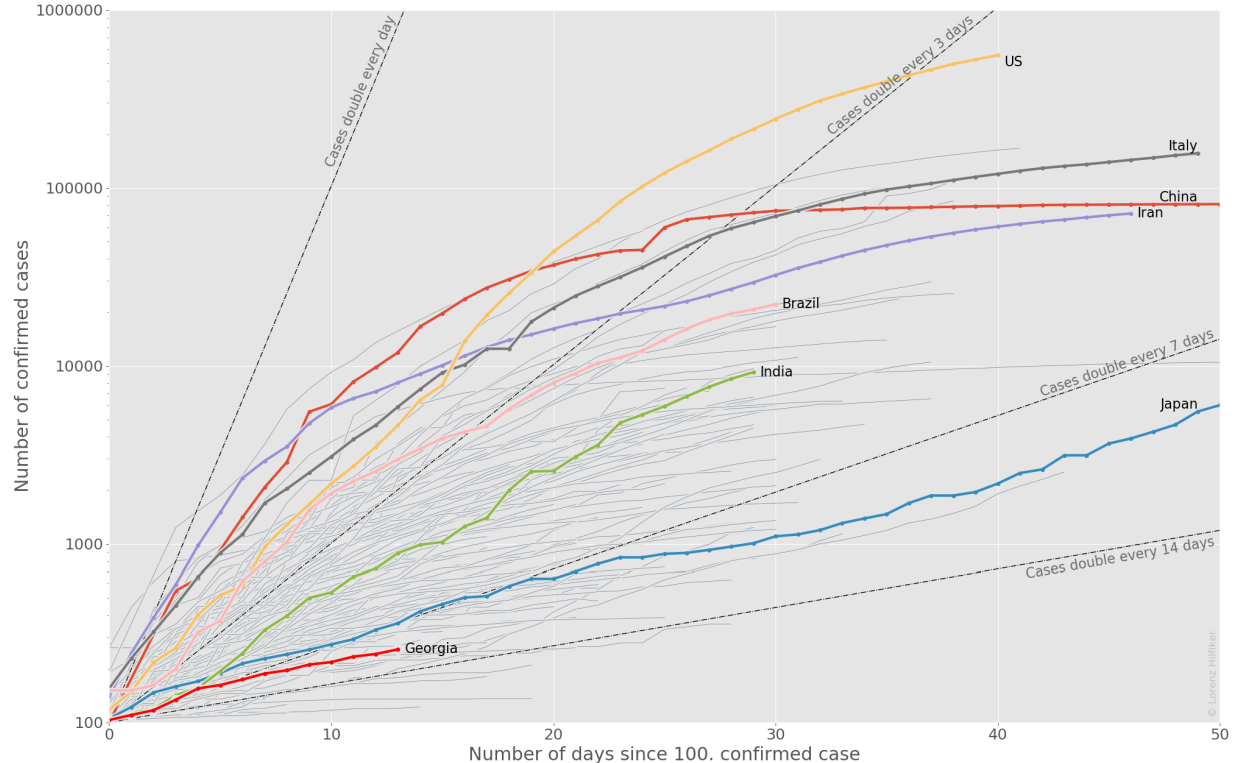
As COVID-19 infections in Georgia continue to grow slowly but steadily, it is time to take a closer look at how this development compares with the outbreaks in other countries. While Georgia is on the same trajectory as Japan, it currently falls short of the benchmark set by some other wealthy east Asian countries. 
14.04.2020. This is the  conclusion made by Dr. Lorenz HILFIKER, a Swiss mathematician based in Tbilisi. With his kind permission, Caucasian Journal is publishing the findings he posted in his blog, which provides data-focused coverage of the COVID-19 crisis in Georgia.

The first cases in Georgia were confirmed around the same time as in many European countries. Yet, the virus has so far spread considerably less than in most of the Western world.

For example, my native country Switzerland recorded its first case on February 25, just one day before Georgia. Today (April 10) the tally for Switzerland stands at about 24 thousand confirmed cases and one thousand fatalities, while Georgia has recorded merely 230 cases and three fatalities to date.

Here is a chart of all countries which have reached 100 cumulative confirmed cases at least a week ago (thin grey lines).

Сlick to enlarge.    Image (c) Lorenz Hilfiker
A straight line in this chart corresponds to exponential growth with a fixed transmission rate. The steeper the slope of a line, the faster the spread of the virus. The four dashed lines indicate exponential growth where cases double daily, every third day, every week and every two weeks, respectively.

Laura THORNTON: “How does democracy work six feet apart?“

The corona virus has disrupted virtually all aspects of our lives and there is much speculation about both the effectiveness of democracy to handle the crisis and the impact the virus will have on democratic institutions and processes in the short and long term.  

11.04.2020 (Caucasian Journal). For an expert opinion on this subject Caucasian Journal has turned to Laura THORNTON, Director for Global Programme at Stockholm-based International Institute for Democracy and Electoral Assistance. Until recently Laura has headed National Democratic Institute in Tbilisi, and is well known in our region. She is also a frequent guest of СJ (see her other interviews here).

Alexander KAFFKA, editor-in-chief of CJ: Much has been said about autocracies being “better equipped” to handle corona due to their ability to take draconian measures. How would you respond to this? 

LT: Yes, there is plenty of bemoaning the inability of democracies to quickly adopt the tough measures, including limiting freedoms, to address the virus, the assumption being that non- or hybrid- democracies do this more effectively as they are not hindered by checks or bureaucracy, like China and Singapore. This position is, of course, swiftly countered by those pointing out the successes of democracies like Germany, Taiwan, and South Korea, where immediate and efficient actions – including large scale testing, tracking, and isolating cases – have proven effective. There is also evidence of established democracies crippled by incompetence and bureaucracy. Successful responses reflect mostly the competence and efficacy of states and, in my view, provide a more compelling case than ever for good governance – efficient, nimble, responsive, transparent, and organized.

COVID-19 situation in South Caucasus

Caucasian Journal has added a special COVID Page to our main menu. On that page the readers can find real time statistical data on corona virus situation in Georgia, Armenia, Azerbaijan.


You are welcome to use this COVID widget for your page. Contact us to get embedding code.

We will be adding more tools to visualize the COVID data, as well as links to useful resources.

Our COVID Page can be found at https://english.caucasianjournal.org/p/covid.html. 


Noubar Afeyan talks about his company's COVID-19 vaccine at webinar held by Armenian organizations

Global mass medias have reported the good news about the first coronavirus vaccine developed by Moderna Therapeutics, a Cambridge-based biotech company. The company also became the first to start human trial testing of its novel vaccine. We are pleased to find a strong “Caucasian connection” at the very frontline of global struggle against COVID-19: Moderna’s founding father and chairman, Dr. Noubar Afeyan, is also co-founder of the Foundation for Armenian Science and Technology (FAST), and an active participant of other Armenian projects related to science.

On March 28 Dr. Noubar Afeyan participated in the online webinar “COVID-19: Challenging General Fear”. Caucasian Journal is pleased to present the video of his presentation. The webinar, moderated by well-known entrepreneur and venture philanthropist Ruben Vardanyan, was co-organized by a number of Armenia-based organizations including Armenia2041.org, IDeA Foundation, Aurora Humanitarian Initiative, UWC Dilijan College, Foundation for Armenian Science and Technology (FAST).


Below is the full version of webinar “COVID-19: Challenging General Fear”. The speakers include: